
The AirDoctor 5500 is worth considering if you have one large living space and the budget to keep replacing its filters. For a small bedroom, I would start with a smaller model. Before spending this much, measure the room and work out where the purifier will sit.
About this review: This is a researched assessment of published specifications and ownership costs. We have not tested the 5500 in our own home or measured its noise, electricity use or cleaning speed. Prices were checked on September 22, 2026.
Disclosure: HomeVib may earn a commission if you buy through our affiliate links, at no extra cost to you.
AirDoctor 5500 at a glance
| Specification | Manufacturer listing |
|---|---|
| Classic model price | $999 |
| Smoke CADR | 556 cubic feet per minute |
| Advertised coverage | 1,043 square feet at four air changes per hour |
| Size | 16 inches wide × 16 inches deep × 28.75 inches tall |
| Weight | 33 pounds |
| Filters supplied | Two permanent prefilters, two Carbon/VOC filters and two UltraHEPA filters |
| Controls | Auto mode; Smart version adds Wi-Fi and app control |
Source: AirDoctor’s 5500 specifications. These are published figures, not HomeVib test results. Check which version is selected when comparing prices.
Check current AirDoctor offers
How much room can it realistically cover?
Floor area alone can be misleading. A room with a tall ceiling contains more air than the same floor plan with a standard ceiling. The EPA’s guide to home air cleaners recommends accounting for ceiling height and the whole connected area in an open layout. It also notes that CADR is typically measured at the highest fan speed.
Here is a simple way to put the published CADR into context. Divide 556 × 60 by the room’s volume in cubic feet. That gives an estimated equivalent air-change rate for particle removal.
| Example space | Calculated equivalent air changes per hour |
|---|---|
| 600 sq. ft., 8-foot ceiling | 6.95 |
| 800 sq. ft., 8-foot ceiling | 5.21 |
| 1,000 sq. ft., 8-foot ceiling | 4.17 |
| 1,000 sq. ft., 10-foot ceiling | 3.34 |
These are our calculations using the manufacturer’s smoke CADR, not measurements in real rooms. They assume well-mixed air and operation at the rated output. Furniture, layout and lower fan settings can change the result. Filtered recirculation also does not bring fresh outdoor air inside.
My buying rule would be to leave some capacity to spare. I would be cautious about choosing any purifier right at its advertised room limit, particularly if I expected to keep the fan low while watching TV.
What the filters cost
The 5000 Series one-year filter pack fits the 5500 and was listed at $354.99. It contains four Carbon/VOC filters and two UltraHEPA filters. The manufacturer’s usual replacement schedule is six months for carbon and twelve months for UltraHEPA.
That works out to about $29.58 a month when you spread the pack price over a year. It is a budgeting figure, not a monthly payment. It excludes electricity, tax and any shipping charges.
The purifier comes with filters, so do not count a full replacement pack as something you must immediately install on day one. Your first year’s cash spending depends on when you purchase replacements. Once you settle into regular replacement cycles, the annual pack price is a useful way to judge affordability.
AirDoctor’s 5500 filter collection also listed a carbon two-pack at $131 and an UltraHEPA two-pack at $133. Two carbon packs plus one UltraHEPA pack would total $395, compared with $354.99 for the annual bundle. That is a $40.01 difference at the prices checked.
See our AirDoctor filter-cost guide to compare ongoing costs across the range. I would do this before looking at a sale price on the machine itself.
Where I would use it, and where I would hesitate
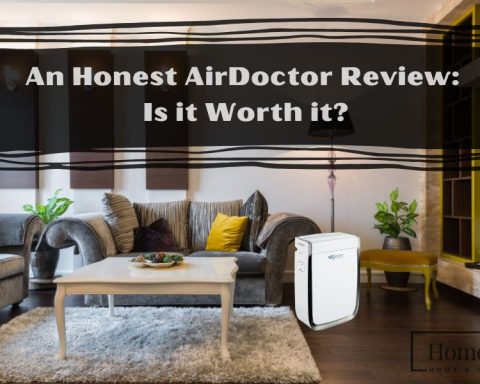
A large, shared living area: This is the use case I would put first on the shortlist. Measure the whole space you want it to serve, including an adjoining dining area if there is no door between them.
A small bedroom: I would compare smaller units first. Check the AirDoctor model comparison rather than paying for the largest model by default.
Several separate bedrooms: I would plan room by room. EPA describes portable purifiers as devices for a single room or area. A large unit downstairs should not be treated as a promise of equally clean air behind closed doors upstairs.
A spot beside the sofa: Mark out the footprint before ordering. Think about walking space, the power cord and access for filter changes. Keep airflow clear of curtains and furniture, as EPA advises.
Classic or Smart?
I would pay extra for app control only if I could name a regular use for it. For example, would you actually change settings remotely? If you expect to leave the machine running and adjust it at the unit, put more weight on room size and replacement costs.
Compare the final basket totals for both versions, including any subscription selections. A promotional offer can change the price difference, so there is little value in choosing a version from an old discount screenshot.
What this review cannot tell you
We have not measured the sound beside a bed or sofa. We also have no HomeVib test showing how quickly this model clears a room after cooking. I would not turn a manufacturer’s description of quiet operation into a hands-on verdict.
Likewise, particle CADR does not rate gas removal. EPA explains that gas filtration depends on suitable filter media and that filtration supplements source control and ventilation. A purifier is not a fix for an ongoing pollution source.
Should you buy the AirDoctor 5500?
I would shortlist it for a large open room if the annual filter budget feels reasonable. I would compare alternatives before buying it for a modest bedroom or expecting one machine to cover a divided house.
If you are torn between sizes, our AirDoctor 3500 vs. 5500 comparison is the next useful read. The AirDoctor 4000 review covers another option to weigh up.
The decision I would make first is simple: which room needs the purifier, and what will it cost to keep using it? Answer those two questions before choosing the model.