
Updated September 2026: I rechecked the coverage, smoke CADR, dimensions, weight, and filter schedule against AirDoctor’s current product and support pages. Prices and promotions change.
Disclosure: This article contains affiliate links. If you buy through one of them, HomeVib may earn a commission at no extra cost to you.
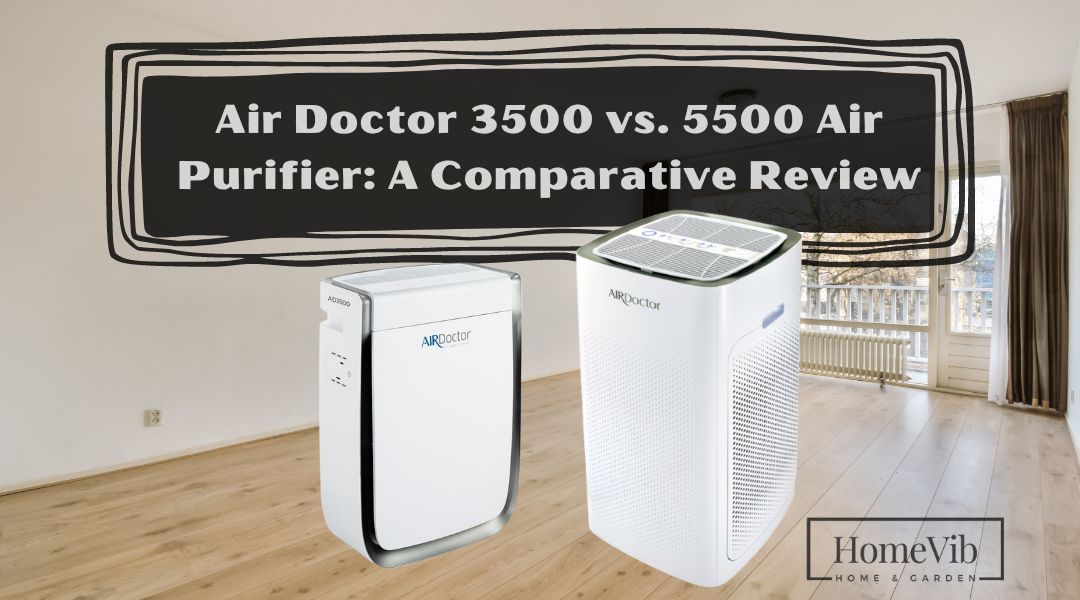
The main difference between the AirDoctor 3500 and 5500 is airflow. The 3500 is rated for 630 square feet at four air changes per hour. The 5500 is rated for 1,043 square feet at the same rate and has a much higher smoke CADR.
I have used the AirDoctor 3500 for several years. I have not tested the 5500 in my home, so my comments about that model are based on current manufacturer specifications rather than hands-on measurements.
Quick answer
Choose the AirDoctor 3500 for a medium or large room when you want a narrower, lighter unit and 340 CFM of smoke CADR is enough for the space.
Choose the AirDoctor 5500 for a larger open area that needs more airflow. Its smoke CADR is 556 CFM, but it is also wider, taller, almost twice as heavy, and uses two UltraHEPA filters and two carbon/VOC filters.
The 5500 is not automatically the better buy. Paying for more airflow only makes sense if the room needs it.
| Specification | AirDoctor 3500 | AirDoctor 5500 |
|---|---|---|
| Coverage at 4 ACH | 630 sq. ft. | 1,043 sq. ft. |
| Smoke CADR | 340 CFM | 556 CFM |
| Dimensions | 15.75 W x 8.75 D x 23 H inches | 16 W x 16 D x 28.75 H inches |
| Weight | 18 lb | 33 lb |
| Main filter sets | One UltraHEPA and one carbon/VOC filter | Two UltraHEPA and two carbon/VOC filters |
| Versions | Classic and Smart | Classic and Smart |
| Current price | Check 3500 price See current offer |
Check 5500 price See current offer |
Coverage and CADR figures in this table are from AirDoctor. They are not results from my own lab testing.
AirDoctor 3500: the easier fit for most rooms
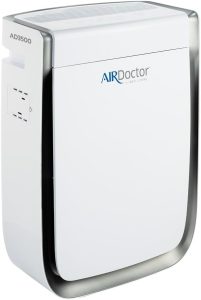
The 3500 has a slim rectangular body, so it is easier to place near a wall than the deeper 5500. At 18 pounds, it is also much easier to move between rooms.
AirDoctor rates it for 630 square feet at four air changes per hour, with a smoke CADR of 340 CFM. I use mine in an open living and kitchen area and in the bedroom. Auto Mode is the feature I rely on most. The fan changes speed when the particle sensor detects a change, so I do not have to keep adjusting it.
The downside is that high fan speed is audible and replacement filters are a real ongoing cost. My full AirDoctor 3500 review covers my longer-term experience, setup, noise, and maintenance.
AirDoctor 5500: more airflow for a much larger room
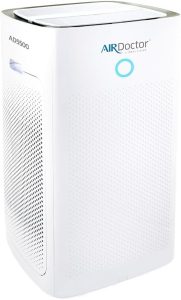
The 5500 is built for extra-large rooms and open spaces. AirDoctor rates it for 1,043 square feet at four air changes per hour, and its smoke CADR is 556 CFM. That is a meaningful jump from the 3500.
The extra capacity comes with a larger body. The 5500 is 16 inches deep and weighs 33 pounds. It also uses two UltraHEPA filters and two carbon/VOC filters, so replacement costs should be part of the decision.
I would not put the 5500 in a room that the 3500 can already handle well. The larger model makes sense when the room size and layout call for the higher CADR.
Coverage and CADR
Use the four-air-changes-per-hour coverage figure when comparing these models. AirDoctor also advertises larger room figures at fewer air changes, but the four-ACH number is the more useful starting point for regular particle removal.
CADR tells you how much filtered air a purifier delivers for a particular pollutant. The 5500’s 556 CFM smoke CADR is about 64 percent higher than the 3500’s 340 CFM. That does not mean it cleans every room 64 percent better. It means it is built to move more filtered air and suit a larger space.
Room shape, ceiling height, open doors, fan speed, and the source of the pollution still affect what happens in a home. The EPA also notes that portable air cleaners can reduce some pollutants but cannot remove all pollutants.
Filters and running costs
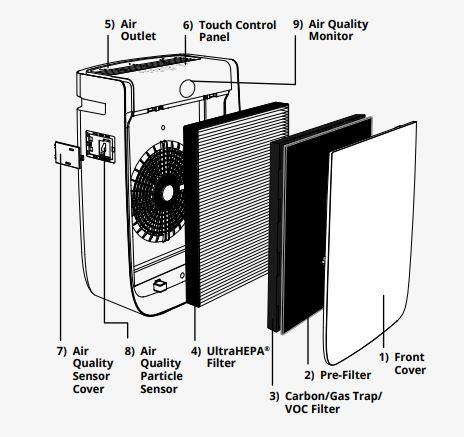
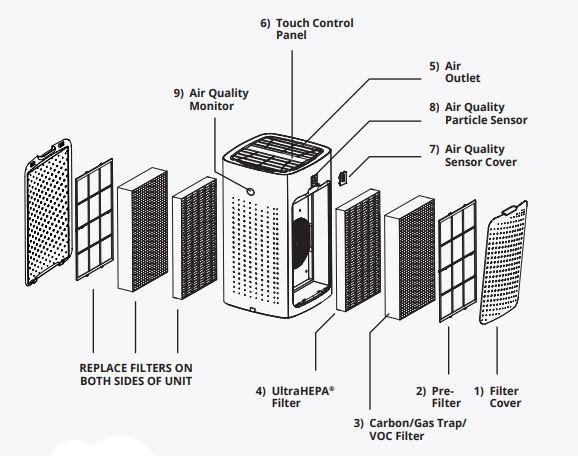
Both models use a pre-filter, a carbon/VOC filter, and an UltraHEPA filter. AirDoctor says the UltraHEPA filter was tested to capture 99.99 percent of particles down to 0.003 microns under laboratory conditions. That is a manufacturer claim, not a measurement I verified myself.
The 3500 uses one of each main replacement filter. The 5500 uses two of each. AirDoctor’s support guidance says to replace the carbon/VOC filters about every six months and the UltraHEPA filters about every 12 months, depending on use and air quality.
The 5500 may not need twice the annual spending in every home, but it requires pairs of filters. Check current replacement prices for both models and estimate a full year before choosing.
Size, placement, and noise
The 3500 is 15.75 inches wide, 8.75 inches deep, and 23 inches high. The 5500 is 16 inches wide, 16 inches deep, and 28.75 inches high. The width looks similar on paper, but the 5500 is much deeper and taller.
Think about the actual spot where the purifier will sit. Leave the intake and outlet clear, and do not hide the unit behind furniture. If you plan to move it often, the 18-pound 3500 is the practical choice. The 33-pound 5500 is better treated as a machine that stays in one large area.
I can hear my 3500 when it moves to its highest setting. I have not measured either model with a sound meter, so I would not choose between them based only on published decibel figures. More airflow generally means more fan noise.
Classic or Smart?
Both models are sold in Classic and Smart versions. The Smart versions add Wi-Fi, app control, and an air-quality forecast. The filtration and basic room-size decision come first. Pay extra for the app only if remote control is useful to you.
Which one should you buy?
- Buy the 3500 if the room is within its 630-square-foot four-ACH rating, you want a slimmer unit, or you expect to move it.
- Buy the 5500 if the room is clearly larger, the 556 CFM smoke CADR suits the space, and you accept the larger filter set and footprint.
- Buy neither yet if you have not measured the room or compared annual filter costs.
There is also a middle option. The AirDoctor 4000 is rated for 694 square feet at four air changes per hour with a smoke CADR of 370 CFM.
Frequently asked questions
Is the AirDoctor 5500 better than the 3500?
It is more powerful, but it is not the better choice for every room. The 5500 has a higher CADR and larger coverage rating. The 3500 is smaller, lighter, and enough for many medium or large rooms.
How much larger is the AirDoctor 5500?
It is roughly the same width but much deeper and taller. It weighs 33 pounds compared with 18 pounds for the 3500.
Do the 3500 and 5500 use the same number of filters?
No. The 3500 uses one UltraHEPA and one carbon/VOC filter. The 5500 uses two of each.
How often are the filters replaced?
AirDoctor recommends roughly six months for the carbon/VOC filters and 12 months for the UltraHEPA filters. Actual timing depends on use and air quality.
More AirDoctor guides
- Read the AirDoctor 5500 review for room-size examples and ownership costs
- Compare every current AirDoctor model
- See AirDoctor filter costs by model
- Compare the AirDoctor 2000 and 3500
Sources
- AirDoctor 3500 product specifications
- AirDoctor 5500 product specifications
- AirDoctor filter replacement guidance
- US EPA guide to air cleaners and air filters
More AirDoctor ownership help
Before choosing between the two sizes, check the troubleshooting guide so filter alerts and sensor issues do not get mistaken for a model problem.