

Updated September 2026: I rechecked the AirDoctor 3500 specifications and filter schedule against AirDoctor’s current product and support pages. Prices and promotions can change.
Disclosure: This article contains affiliate links. If you buy through one of them, HomeVib may earn a commission at no extra cost to you. I bought my AirDoctor myself. It was not supplied for this review.
I bought the AirDoctor 3500 after developing allergies and spending more time working from home with two pets. I have now used it for several years, mostly in our open living and kitchen area and in the bedroom.
My quick verdict
The 3500 has been easy to live with. I leave it on Auto Mode, the controls are simple, and the fan responds when cooking or other particles affect the sensor. The drawbacks are the replacement-filter cost and the noise when the fan moves to a high setting.
This review focuses on the 3500 I own. Specifications are manufacturer figures unless I clearly describe something I noticed in my own home. I did not run laboratory particle tests, so I will not pretend that I did.
| Air Purifier | Air Doctor 3500 |
| Room Size Coverage | 630 sq. ft. 4x/hour |
| CADR (Smoke)/CFM | 340 |
| Fan Speeds | 4 |
| Noise Level | 39-59 dB |
| Power Consumption | 11 – 110 W |
| Dimensions | 15.75″ (W) x 8.75″ (D) x 23″ (H) |
| Weight | 18 lbs |
| Price | Check Here |
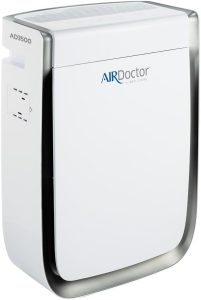
After several years of use, I still think it earns its space in our home.
Pros
Cons
Here is what mattered to me before buying, and what I would check now:
-
What the AirDoctor actually does (and how it works)
-
The different models and which one’s right for your space
-
What it’s like to use day-to-day
-
Filter costs, noise levels, and performance
-
And most importantly-is it worth the money?
What Is AirDoctor?
AirDoctor is a portable purifier made to circulate filtered air through a room. It is one tool for reducing some airborne particles, not a replacement for ventilation or source control.
The 3500 uses an UltraHEPA filter. AirDoctor says its laboratory testing captured particles as small as 0.003 microns; that figure describes the test conditions, not a promise about every home.
To put it simply: if you’re concerned about allergens, wildfire smoke, pet dander, VOCs, or fine airborne particles, the filter is designed to capture particles as air passes through it, through the filter.
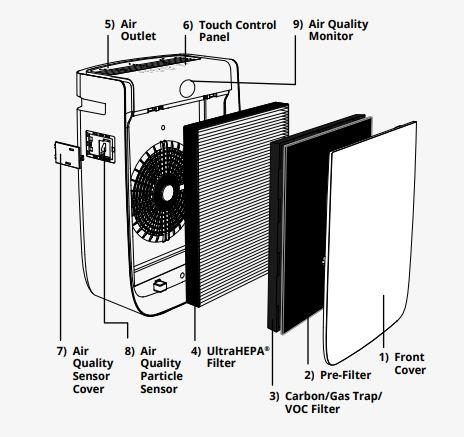
It uses a 3-stage filtration system:
- Pre-filter: Traps larger particles like dust, hair, and lint. It also helps extend the life of the other filters.
- Dual-Action Carbon/Gas Trap VOC Filter: Absorbs toxic gases, odors, and volatile organic compounds (VOCs) like formaldehyde. This part is especially helpful for cooking smells, chemical cleaners, or off-gassing from furniture.
- UltraHEPA® Filter: the main particle filter-it removes 99.99% of ultra-fine particles, including pollen and smoke particles under the manufacturer’s test conditions.
The three stages handle different parts of the job. In my home, the practical benefit is being able to leave the unit on Auto Mode and let the fan respond to changes in the room.
How Does AirDoctor Work?

The main convenience is Auto Mode. After the filters are installed, I can leave the unit running and let the sensor control the fan.
It uses a built-in air quality sensor to detect particles and pollutants. Based on what it senses, the fan speed adjusts automatically-higher when it picks up smoke, allergens, or odors, and lower when the air is clean. I do not need to adjust the fan every time the room gets smoky or dusty.
Air Quality Indicator Light
There’s a color-coded light on the front that tells you what the air quality is like at any moment:
- Blue = Good air quality
- Orange = Moderate
- Red = Poor (this is when you’ll hear it kick into high gear)
It also has a few optional features like an ionizer (which I usually keep off), a timer, and a light dimmer-useful for nighttime use.
I leave mine on Auto Mode most of the time. When cooking or cleaning adds more particles, I can hear the fan speed change and then settle again.
How the 3500 fits into the AirDoctor range
AirDoctor offers five current core models; availability of the AirDoctor 2500 can vary, and choosing the right one really depends on the size of your space and how you plan to use it. I personally use the AirDoctor 3500, and it’s been great for our open living/kitchen area and bedroom. But there’s something for every room size.
Here’s a quick breakdown to help you compare:
AirDoctor 1000

- Best for: Small bedrooms, nurseries, home offices, laundry rooms
- Covers: 285 sq. ft. 4x/hour or 570 sq. ft. 2x/hour
- Compact and budget-friendly-great for tight spaces
AirDoctor 2000
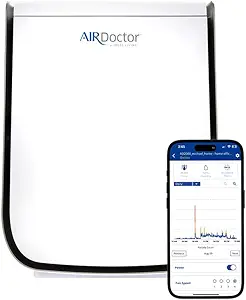
- Best for: Small-to-medium rooms
- Covers: 305 sq. ft. 4x/hour or 610 sq. ft. 2x/hour
- Slightly more power than the 1000, still space-saving
AirDoctor 2500

- Best for: Kids’ rooms, offices, kitchens, garages
- Covers: 420 sq. ft. 4x/hour or 840 sq. ft. 2x/hour
- Comes with a remote control and can be wall-mounted-convenient
AirDoctor 3500 (formerly the 3000)
- This is the one I use!
- Best for: Living rooms, master bedrooms, large open rooms
- Covers: 630 sq. ft. 4x/hour or 1,260 sq. ft. 2x/hour
- A size that works well for medium and larger rooms
AirDoctor 4000
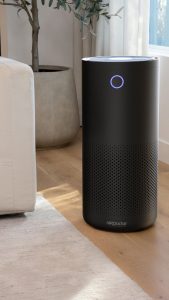
- Best for: Medium to large rooms
- Covers: 694 sq. ft. 4x/hour
- Features 360° air intake and triple filtration with UltraHEPA + Dual-Action Carbon
- Sleek, newer design with newer design
- I wrote Airdoctor 4000 review before.
AirDoctor 5500 (formerly the 5000)

- Best for: Extra-large rooms, open concepts, high ceilings
- Covers: 1,043 sq. ft. 4x/hour or 2,086 sq. ft. 2x/hour
- Larger unit with dual fans for bigger spaces
A Note on Wi-Fi Versions
Models 2000, 3500, and 5500 are also available in Wi-Fi-enabled versions, which let you control settings via your phone.
Personally, I went with the standard version-I prefer fewer connected devices-but the option is there if you want it.
My advice?

Start by measuring the room you’ll use it in most often. If you’re between sizes, size up.
We started with one unit and are already planning to get another so we don’t have to keep moving it room to room.
Performance & Testing
My 3500 has been useful in day-to-day life, but I did not run a controlled performance test. My observations are limited to how it behaves in my rooms.
I noticed less dust on nearby surfaces and fewer problems with cooking smells, although those observations are not a controlled test.
The more useful comparison points are the published CADR, coverage rating, and filter specifications.

Real-World Testing
AirDoctor publishes CADR and room-coverage figures for the 3500. I have not independently measured how quickly it cleans a room, so I am not presenting a time estimate.
The 0.003-micron figure comes from AirDoctor’s laboratory testing. It should not be read as a guarantee of household results.
The particle filter and carbon/VOC filter are designed for different pollutants. Actual results depend on the room, the source, and how the unit is used.
CADR Ratings
The published CADR figures are:
- Smoke CADR: 340 CFM
- Official room coverage: 630 sq. ft. at 4 air changes per hour
- Filter system: pre-filter, Carbon/VOC filter, and UltraHEPA filter
CADR is useful for comparing airflow between purifiers, but it does not predict exactly what will happen in every room.
My Personal Test Moments
A few examples from my own experience:
- After cooking, I have seen the red light come on and the fan speed increase. The smell usually clears faster with the unit running, although I have not measured the difference.
- During wildfire season, I kept it running with the windows shut. A purifier can reduce some airborne particles, but it does not make indoor air completely safe.
- And when cleaning or vacuuming stirred up dust, I’d see it go into overdrive for a few minutes, then settle once the air cleared.
I can see the sensor light and hear the fan respond when the room changes, which is useful in everyday use.
User Experience Highlights
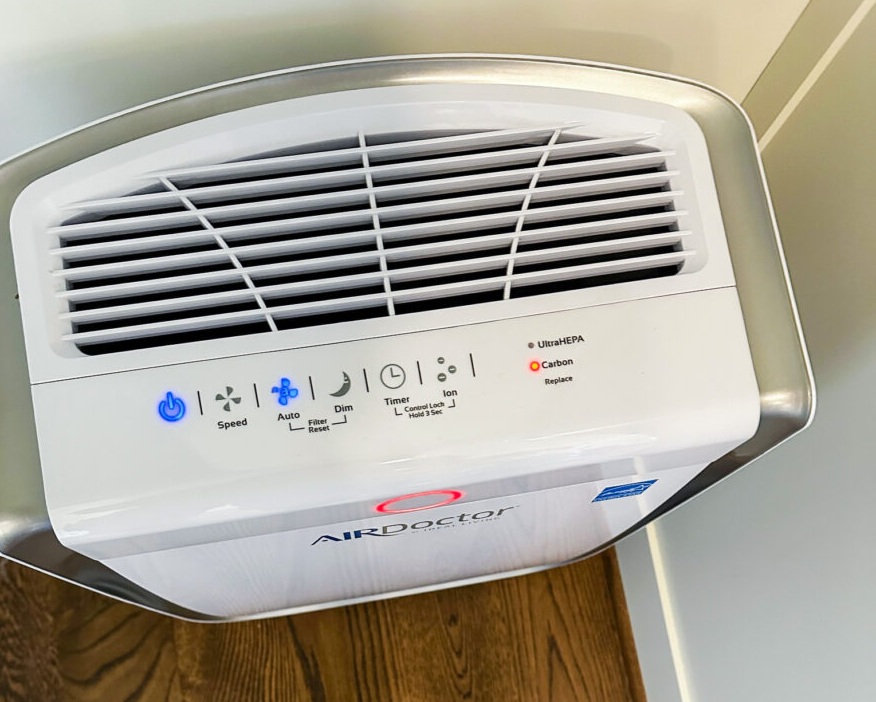
After using the AirDoctor daily for a few years, the useful design choices I notice most are simple controls, Auto Mode, a dimmable display, and a filter alert.
Here are a few things that stood out to me:
Easy Setup
When it arrived, setup took less than five minutes. You just unbox it, remove the plastic from the filters, pop them back in, and plug it in. That’s it-no confusing instructions or app configuration unless you choose the Wi-Fi model.
Simple, Stress-Free Maintenance
I vacuum the pre-filter once a month (a quick two-minute task) to keep it running efficiently. The machine lets me know exactly when to change the filters-so there’s no guesswork. Replacing them is straightforward and takes a few minutes.
And when it’s time to reset the filter light? Just press and hold the Auto and Dim buttons for 3 seconds. Done.
Quiet Operation
Unless it’s working hard to clean something up, it runs quietly-especially on Auto Mode. It’s quieter than our AC, and even our fridge. I often forget it’s on.
Night Mode
A useful bedroom feature is the ability to dim or completely turn off the lights on the machine.
Portable
Even the larger 3500 model is surprisingly easy to move between rooms. We shift ours from the living room to the bedroom depending on the season or what’s going on that day.
App-Free (Unless You Want It)
We purposely went with the non-Wi-Fi version because we didn’t want another device to manage through an app. But if you love smart home control, some models do offer a Wi-Fi upgrade.
Filter Lifecycle & Maintenance 
A common maintenance question is: “How often do you have to replace the filters?” The schedule depends on the filter type, use, and indoor air quality.
Filter Replacement Schedule
AirDoctor recommends replacing the filters on different schedules: the Carbon/VOC filter is generally replaced every 6 months, while the UltraHEPA filter is generally replaced every 12 months, depending on your usage and indoor air quality. The machine shows when the filters need attention, so I do not have to keep a separate reminder.
Here’s a quick breakdown:
- Pre-filter – This one’s reusable! Just vacuum it gently about once a month. It catches hair, dust, and large particles before they hit the other filters, so keeping it clean helps everything else last longer.
- Carbon/VOC filter – Typically lasts 6 months, especially if you cook often or live in a city with more pollutants.
- UltraHEPA filter – Usually good for 12 months, depending on how hard it’s working in your space.
How to Reset the Filter Light
After replacing the filter, AirDoctor’s 3000/3500 support instructions say to hold Auto and Dim together for 5 seconds, until the alert turns off. Follow your exact model’s manual if its controls differ.
A red air-quality indicator is a different issue. Our AirDoctor troubleshooting guide covers sensor cleaning, filter alerts and Wi-Fi setup.
Filter Costs
Replacement filter costs vary by model, but here’s what you can expect:
- Around $45-$60 per filter for smaller units
- Around $100-$125 per filter for larger ones
- If you buy a bundle directly from AirDoctor, you can save quite a bit. Our filter spending has been about $100-$250 per year, although the exact cost depends on the replacement schedule and sales.
Maintenance is straightforward, but it is not free. Keep the pre-filter clean, replace the other filters on schedule, and budget for replacement sets.
Pricing & Best Purchase Strategy
AirDoctor costs more than many basic purifiers, so the purchase only makes sense if the room-size rating, controls, and filter system fit your needs.
Older list prices in the original article are no longer reliable. Check the current price, any bundle terms, and the annual filter cost before buying.
Prices and promotions change frequently, so compare the current list price, bundle terms, and annual filter cost before buying through the promo link (like mine). You can usually save $100 to $300, depending on the model.
Tip:
If you’re planning to buy more than one unit or want extra filters, check their bundle deals-you’ll often get a better price per unit or discounted replacement filters.
If you are considering HSA/FSA funds, check your plan administrator’s rules before buying.
So, What’s the Best Deal?
I would still choose the 3500 for the rooms where I use it. If you need coverage for a large open-concept area or multiple floors, compare the 5500 against the filter cost and noise before deciding.
Check the current price and filter cost before buying. Promotions change, so I have removed fixed price claims from this review.
How Does AirDoctor Compare to Other Air Purifiers?

Before I bought the AirDoctor, I did what any health-conscious overthinker does-I researched every possible brand. Dyson, Molekule, Levoit, Blueair, Coway… you name it, I read the reviews and crunched the numbers.
Here’s what made AirDoctor stand out:
What Sets It Apart
- UltraHEPA Filtration – Most air purifiers use regular HEPA filters, which capture particles down to 0.3 microns. AirDoctor’s UltraHEPA goes all the way down to 0.003 microns, which is 100x smaller. That is a laboratory filtration claim, not a promise about health outcomes.
- Built-in VOC/Carbon Filter – The carbon stage is intended for odors and some gases. Its real effect depends on the source, the room, and how often the filters are changed.
- Auto Mode & Air Quality Sensor – The fan changes speed when the sensor detects a change in the room. I find that easier than adjusting it by hand.
- Published CADR Rating – The 340 CFM smoke CADR gives you a useful number to compare with other models.
- Cost – The 3500 is not a budget purifier, so compare the purchase price and yearly filter cost before buying.
Where Other Brands Might Win
- Design Aesthetics – Some brands like Molekule or Dyson focus heavily on style. AirDoctor looks clean and modern, but it’s not trying to win a design award.
- Smart App Integration – If having full control from your phone is a must, you might lean toward other Wi-Fi-enabled purifiers. (AirDoctor does offer Wi-Fi models for 2000, 3500, and 5500-but I chose the standard version.)
- Noise – High fan speed is clearly audible. If noise matters, compare published measurements and, if possible, listen to the model before buying.
I chose the 3500 because its size and airflow fit the rooms where I use it. That does not make it the best purifier for every home, and I have not compared every competing model under the same conditions.
Who the AirDoctor 3500 suits
The 3500 is a practical fit for a medium or large room when you want automatic fan control and a carbon filter as well as particle filtration. In my home, the clearest day-to-day benefit is that I can leave Auto Mode running without adjusting it constantly.
Pet owners and people dealing with seasonal smoke may value the pre-filter and carbon/VOC stage, but a purifier is only one part of indoor-air care. The EPA says portable air cleaners can reduce some indoor pollutants but cannot remove every pollutant. Ventilation and removing the source still matter.
If you have asthma, COPD, allergies, or another health condition, treat an air purifier as a household appliance, not medical treatment. Ask a qualified clinician about health decisions.
Is the AirDoctor 3500 worth it?

For me, yes. After several years, it still earns its space because it is simple to run and has enough airflow for the rooms where I use it. That does not make it the right choice for everyone.
Before buying, compare the 630-square-foot rating at four air changes per hour, the 340 CFM smoke CADR, the unit’s size, and a year of replacement filters with other purifiers. If you need more airflow, read my AirDoctor 3500 vs. 5500 comparison. If you prefer a round design, see the AirDoctor 4000 review.
Check the current AirDoctor price and terms.
Frequently Asked Questions
How often do I need to replace AirDoctor filters?
The UltraHEPA and carbon/VOC filters typically need to be replaced every 6-12 months, depending on your air quality and usage. The pre-filter should be vacuumed monthly to keep everything running efficiently. Luckily, the unit will notify you when it’s time.
Does AirDoctor help with odors?
Yes. The carbon VOC filter is designed to absorb odors from cooking, pets, smoke, and household chemicals. In my experience, lingering smells clear out much faster with the unit running.
Is AirDoctor loud?
On Auto Mode, it’s quiet (around 30-40 dB). It only gets louder on high speed-which only kicks in temporarily when air quality drops. Even then, it’s not disruptive and usually quiets down quickly.
Can AirDoctor remove smoke and VOCs?
It can help. It’s especially effective during wildfire season or when using cleaning products. The UltraHEPA filter captures smoke particles, while the carbon filter traps VOCs (volatile organic compounds).
Is it hard to set up?
No. Setup takes less than five minutes. Just remove the filters from their plastic wrap, insert them back into place, plug in the unit, and turn it on.
Should I get the Wi-Fi version?
That depends. The Wi-Fi-enabled models (available for 2000, 3500, and 5500) allow you to control your unit via app. I went with the standard version to keep things simple, but the Wi-Fi option is great for smart-home users.
Can I use HSA or FSA funds?
Eligibility varies by plan and personal circumstances. Check with your plan administrator before buying and do not assume the purchase will qualify.
More AirDoctor guides
- Compare every current AirDoctor model
- See AirDoctor filter costs by model
- Compare the AirDoctor 2000 and 3500